
Why your back is stiffer in the morning than in the evening
What happens in your back at night, why a new mattress often doesn’t solve it, and how ANDUFIT, a massage module under your mattress, loosens your back before you even get up.


The first fifteen minutes of the day
The alarm goes off. You turn over, and there it is again. Your back feels like a plank. You carefully put your feet on the floor, push yourself up with your hands, and your first steps to the bathroom are smaller than you’d like.
By noon it’s usually gone. During the day you hardly think about it. Until the next morning, when it all starts again.
Many people put it down to their age, their mattress or the way they sleep. That can play a part. But there’s something underneath that almost nobody knows, and it explains why most solutions only half work.
You’re certainly not the only one
people worldwide had low back pain in 2020. It becomes more common as we get older. Global Burden of Disease study, The Lancet Rheumatology, 2023
Low back problems are the leading cause of limitations in daily life worldwide. For many people, they start at the same moment every day: when getting up. Morning stiffness is such a recognizable sign that researchers measured it separately in the Dutch BACE study of older adults with back complaints.
What happens in your back at night
A stiff back in the morning doesn’t start in the morning. It builds up during the night, through three things that happen at the same time.
You lie almost still for hours. During the day, every movement keeps blood flowing to your muscles. At night, that largely stops. Muscles that were already tense get little reason to let go.
Your spine lengthens slightly at night. During the day, your body weight compresses your spine a tiny bit. As soon as you lie down, that pressure disappears and it lengthens again. That’s why you’re a little taller in the morning than in the evening. Research has shown that this makes your lower back noticeably less supple in the morning than in the evening.
The tension of the day comes to bed with you. If you lie down tense, you start the night at a disadvantage.
A night in your back
What happens between going to sleep and getting up
Switch between an ordinary night and a night with the ANDUFIT massage module.
-
You lie down The tension of a long day is still in your back and shoulders.
-
Lying still Your muscles hardly move. Blood flow in your back muscles slows down.
-
Your spine lengthens Without the weight of the day, your spine lengthens slightly again.
-
You wake up stiff Your spine is tighter, your muscles have been still all night and the tension of the day never let go.
-
Back program, 15 minutes You choose the Back program on the massage module under your mattress. Gentle, low-frequency Andullation® vibrations travel along your spine. Your muscles relax and blood flow is stimulated.
-
You fall asleep with a relaxed back You start the night without the tension of the day.
-
Back program, 15 minutes When you wake up, you switch the Back program on again. Your back loosens up while you’re still lying down.
-
You get out of bed Without having to push yourself up with your hands first.
So the moment to act isn’t when you get up, but before.
How is your back doing?
How does your back feel when you get up?
How long does it take for your back to loosen up?
How do you sleep at the moment?
How much do your back or your tension bother you?
How do you wake up?
What have you already tried?
Optional, select whatever applies.
Your recovery score
0 out of 100
Your own ratings for your sleep, your complaints and your mornings, together in one number. The higher it is, the more your nights give back.
Your personal report by email
Compiled under the direction of Dr. Roland Stutz
Your score explained, what you can do yourself and the programs that fit your answers, such as program 8 for your back.
Your report is on its way
Check your inbox in a few minutes, and your spam folder if it hasn’t arrived. Meanwhile, keep reading: below you’ll see what most people have already tried, and what actually works.
What most people have already tried
If you wake up stiff every morning, you’ve probably tried a few things already. None of them are wrong. They just work at the wrong moment, or not for long enough.
Stretching and a hot shower helps for a while
Loosening up after getting out of bed works, but you only start once the stiffness is already there. The next morning you’re back where you started.
A new mattress expensive and uncertain
Worth it if your old mattress is truly worn out. But even on a perfect mattress you lie still for eight hours, and your spine still lengthens at night.
Pain relievers dulls the feeling
They make the morning more bearable, but do nothing about the tension you take to bed.
Massage or physical therapy not every day
It works, and research confirms it. But you can’t go every evening and every morning, and that’s exactly where the problem lies.
Massage helps. The problem is how often.
A large Cochrane review brought together 25 controlled studies with more than 3,000 participants in total. The conclusion: massage eases back complaints, but the effect shows mainly in the short term.
And that’s the catch. A massage or a physical therapy session has to be booked, driven to and paid for every time. Once a week is already a lot. Meanwhile, your back stiffens up every night.
What you really need is relaxation at the two moments that matter: just before you go to sleep and just before you get up. Every day. No appointment needed.
The solution
Massage in your own bed, every evening and every morning
ANDUFIT is a massage module with 20 programs that slides under your mattress or topper. For a stiff back there’s program 8, “Back”: in the evening it relaxes your back muscles after a long day, in the morning it loosens your back before you even get up. You simply keep your own bed.
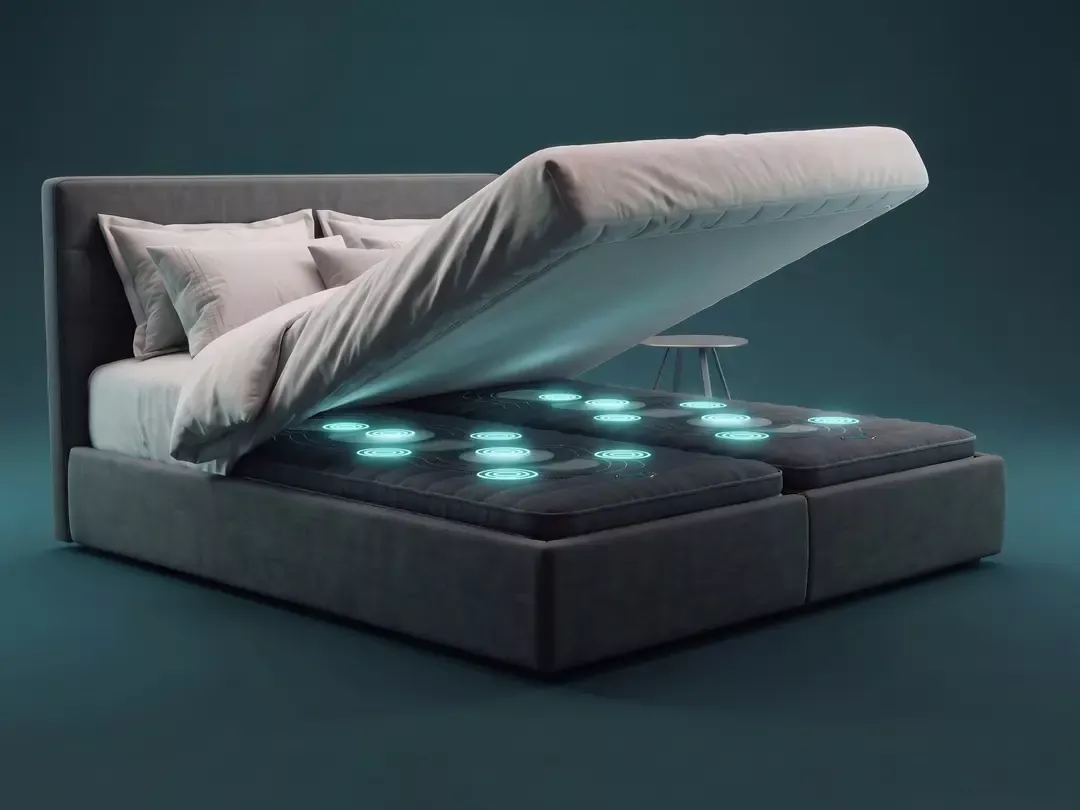 Fits under mattress or topper
Only 2.8 inches high
How it works
Gentle, low-frequency Andullation® vibrations travel through the mattress via seven motors to five body zones, from your shoulders to your calves. They help your muscles relax and support blood flow. The same technology is also used in physical therapy.
Andullation® technology, backed by science
Andullation® was developed in Germany together with universities and is also used in physical therapy. The technology has also been independently studied.
A peer-reviewed study, published on PubMed, followed 50 people who received five half-hour andullation massages. The researchers measured before and after how participants experienced pain, how they felt and how much pressure their lower back could tolerate.
What changed after five sessions
Study of 50 people without a control group, published on PubMed. The pain threshold was measured with a pressure gauge: more pressure was needed before it hurt. ANDUFIT is not a medical device and does not promise any cure. If complaints persist, consult your doctor.
Together in bed, each with your own massage
Share your bed? Then each of you has your own module, each with 20 programs. You choose the Back program, your partner something completely different.
Two modules side by side, each with 20 programs.
A 15-minute program while you lie in bed. You go to sleep without the tension of the day.
The 15-minute Back program when you wake up, before you even get up. Your back loosens up while you’re still lying down.
Curious what ANDUFIT can do for you? Try it for 14 nights in your own bed
You don’t have to take our word for it. Put ANDUFIT under your own mattress and use it for two weeks the way you would every day afterwards: in the evening before sleep and in the morning before you get up. Pay particular attention to how those first steps out of bed feel.
- Night 1 You choose the Back program and the intensity that feels right.
- Week 1 Evening and morning become a fixed moment for your back.
- Night 14 You decide. If you don’t notice a difference, send it back free of charge and get a full refund.
- Free delivery and free returns
- Pay in installments
Sources
- GBD 2021 Low Back Pain Collaborators. Global, regional, and national burden of low back pain, 1990-2020, its attributable risk factors, and projections to 2050. The Lancet Rheumatology, 2023;5(6):e316-e329. Source for “619 million”.
- Feller D et al. Spinal morning stiffness, lumbar disc degeneration and C-reactive protein: the BACE study. Osteoarthritis and Cartilage Open, 2024. PMID 39554477. Source for morning stiffness as a separately measured sign.
- Zander T et al. Diurnal variations in intervertebral disc height affect spine flexibility. Computer Methods in Biomechanics and Biomedical Engineering, 2010. Source for the less supple back in the morning.
- Furlan AD et al. Massage for low-back pain. Cochrane Database of Systematic Reviews, 2015. Source for the short-term effect of massage.
- Parras-Moltó A, Ribas-Serna J. Dose-Response, 2019;17(2). PMID 31105478. Source for the Andullation® results.
This article is an advertorial by ANDUFIT. ANDUFIT is not a medical device and does not replace medical advice. Results vary from person to person.